Many brands rely on bursts of revenue driven by discounts, promotions, or seasonal events. While this can create short-term wins, it often leads to inconsistent growth and shrinking margins.
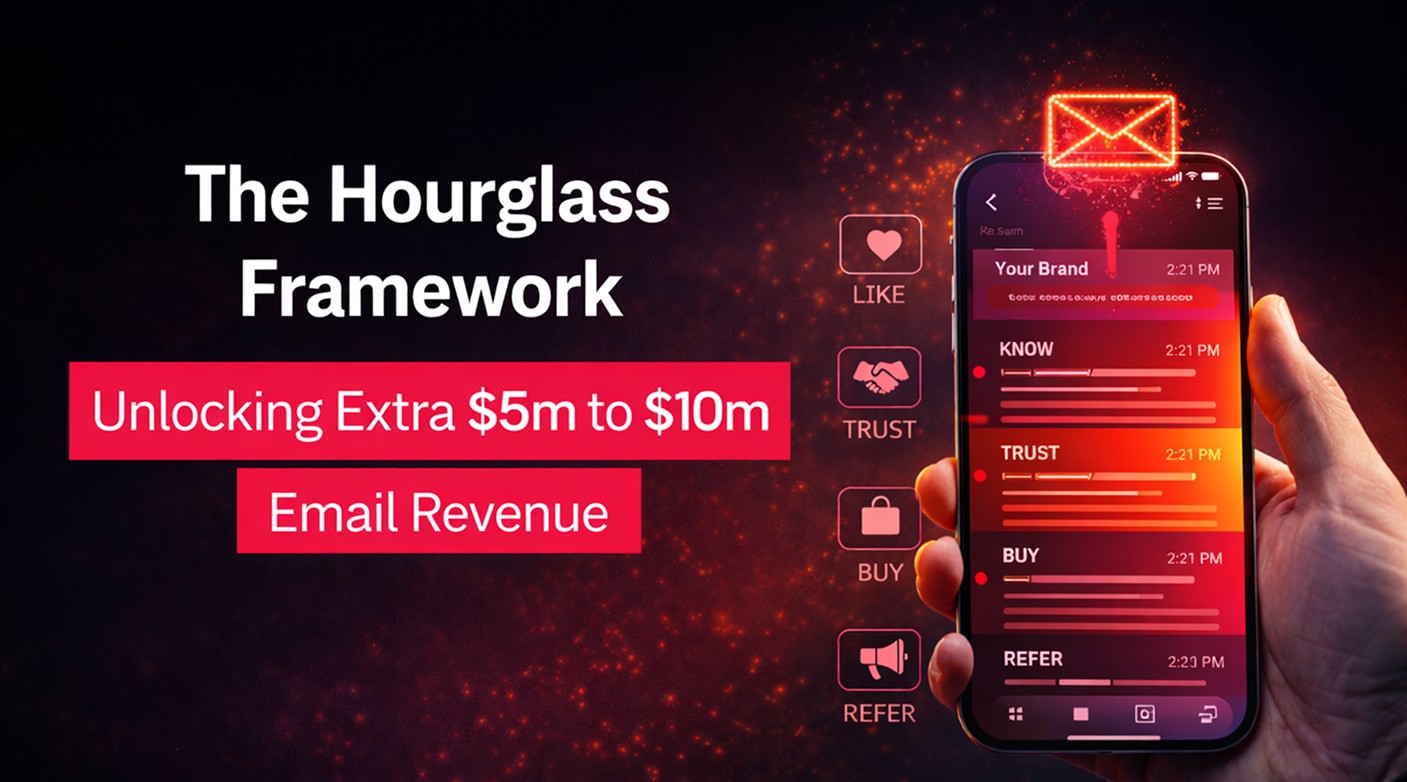
The Hourglass Framework offers a different approach. Instead of focusing only on acquisition, it designs growth across the entire customer lifecycle, turning awareness into advocacy and one-time buyers into long-term revenue drivers.
Sustainable growth is not about pushing harder. It is about building systems that work at every stage.
Why Traditional Funnels Fall Short
Most funnels stop at conversion. Once the purchase happens, the system resets and the brand starts chasing the next new customer.
The Hourglass Framework flips this model. It treats the purchase as the midpoint, not the finish line. Growth continues through retention, repeat purchases, and referrals.
This shift is what allows brands to unlock significantly more revenue from the same audience.
The Hourglass Lifecycle Explained
The framework is built around seven connected stages:
- Know
- Like
- Trust
- Try
- Buy
- Repeat
- Refer
Each stage has a specific role in moving customers forward and increasing lifetime value.
Stages 1–3: Know, Like, Trust
These early stages focus on awareness, familiarity, and credibility.
Email plays a critical role here by:
- capturing leads through high-converting sign-up experiences
- delivering brand story and value clearly
- building confidence with social proof and education
Trust is built before the sale, not after it.
Stage 4: Try
This is where intent turns into action.
The goal is to reduce friction and shorten the time between interest and first purchase. This often includes:
- front-end offers
- product discovery flows
- personalised recommendations
Well-designed email and SMS flows at this stage dramatically improve conversion rates.
Stage 5: Buy
The first purchase is not the win. What matters is what happens immediately after.
Strong post-purchase systems focus on:
- onboarding customers correctly
- setting expectations
- guiding customers toward their next logical action
This stage is where many brands lose momentum by failing to follow up correctly.
Stage 6: Repeat
Repeat customers are the foundation of profitable growth.
At this stage, brands segment customers based on behaviour and value, then tailor messaging accordingly. This includes:
- loyal customers
- high-value buyers
- customers at risk of churning
Retention-focused email strategies consistently outperform acquisition in both cost and ROI.
Stage 7: Refer
The final stage activates advocacy.
Happy customers become promoters through referrals, loyalty programs, and community-driven engagement. This stage creates organic growth that compounds over time.
The strongest growth channel is a customer who sells for you.
Why the Hourglass Framework Works
The framework works because it aligns marketing, email, and customer experience around one goal: lifetime value.
Instead of relying on spikes like Black Friday or constant discounting, brands build predictable, repeatable revenue systems that perform all year round.
Final Thoughts
Scaling email revenue is not about sending more campaigns. It is about designing smarter journeys.
The Hourglass Framework provides a clear structure for brands that want to move beyond short-term tactics and build long-term, defensible growth.